



Edge AI for natural disasters: Faster, smarter response in critical moments
When Hurricane Melissa tore through Jamaica, it became one of the island’s worst natural disasters, isolating 30 communities and causing $7 billion in damage.
For first responders, every second is life-or-death, yet traditional tools stall without internet or power. That’s where edge AI transforms disaster response.
At Latent AI, we’re working to enhance disaster response teams‘ capabilities with cutting-edge AI technology. Our goal is to equip drones and mobile units with tools that deliver real-time damage assessments during natural disasters, even in areas without internet or power. Here’s how we’re pushing the boundaries of disaster response and why it matters for communities like those in Jamaica.
Edge AI: Smarter, faster tools for first responders
In the first hours after a disaster, responders deploy drones and unmanned vehicles to capture aerial imagery and 3D models of affected areas. Equipped with infrared, thermal, multispectral, and lidar sensors, they reveal not only what’s visible but what’s hidden: stranded or trapped persons, water intrusion, or structural weaknesses.
Why centralized AI falls short
Disaster response teams often use aerial footage and AI to assess damage, but traditional methods can hit roadblocks. Centralized AI systems, while powerful, rely on uploading imagery to cloud servers for processing. This can be a process that stalls without a stable internet connection, a common issue during disasters like Hurricane Melissa. Even with fast connections, transferring and analyzing data takes time, delaying critical decisions.
How edge AI solves that problem
Placing AI at the edge on the collection device also offers first responders:
- Reduced latency for real-time action: The first hours are crucial for saving lives, securing safe areas, and prioritizing resources. With AI processed at the point of collection, responders instantly know which buildings are safe for sheltering survivors and which areas require immediate search-and-rescue efforts. AI processed on the drone can detect changes as they are happening, such as a new landslide. Responders can more quickly reroute heavy machinery to clear the blockage, while helicopters are dispatched to airlift survivors from the affected area. The ability to more rapidly pivot prevents delays that could cost lives.
- Precision and adaptability in dynamic disasters: Disaster response teams often rely on centralized AI systems trained for fires, floods, and tornadoes, delivering solid accuracy for known scenarios. However, rapidly changing conditions, such as new landslides or shifting flood patterns, can challenge these systems, as updating models requires transferring large datasets to cloud servers and retraining, which can create delays of hours or days.
In contrast, AI models optimized for compact edge devices, such as drones, are lightweight and require minimal power and memory. These streamlined models can be fine-tuned with small amounts of new data and redeployed in minutes, ensuring precise, real-time damage assessments even as disasters evolve. Tailored for disaster-specific nuances, such as thermal signatures of hidden structural damage or multispectral cues of wildfire impacts, Latent AI models achieve much better performance than standard benchmarks, up to 40% higher accuracy as measured in F1 scores. For responders, this means instant, granular insights that can adapt swiftly to save lives in the critical first hours.
Latent AI’s approach
Latent AI is developing advanced AI models that can run directly on drones and mobile units. By processing data at the point of collection, our technology delivers instant damage assessments, no internet required. Picture a drone over Montego Bay, capturing 3D models and aerial images. At the same time, our AI instantly identifies which buildings are safe or destroyed, providing responders with real-time insights, even in disconnected areas.
We’ve collaborated with government agencies, such as the U.S. Air Force, to tailor edge AI for rapidly evolving disaster zones. Our approach integrates generative AI models into a single edge-deployable system. First, the AI model analyzes imagery to detect buildings and assess damage levels. Then it precisely locates object boundaries and determines building conditions. This AI algorithm was fine-tuned with training data specific to damage assessment (over 850K images of damaged buildings across diverse geographies), teaching it to recognize the visual signatures of structural compromise. Unlike traditional methods that rely on both pre- and post-disaster imagery, our approach operates directly on post-disaster images. This eliminates the need for pre-disaster data, a key limitation that hinders real-time assessment in conventional techniques. Moreover, our method delivers a 40% improvement in accuracy compared to traditional approaches, helping responders pinpoint subtle issues, such as structural weaknesses, that centralized systems might miss.
Testing the future in real disasters
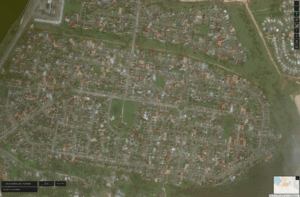
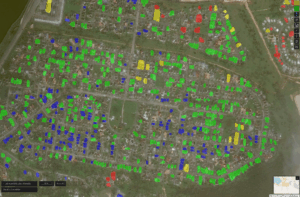
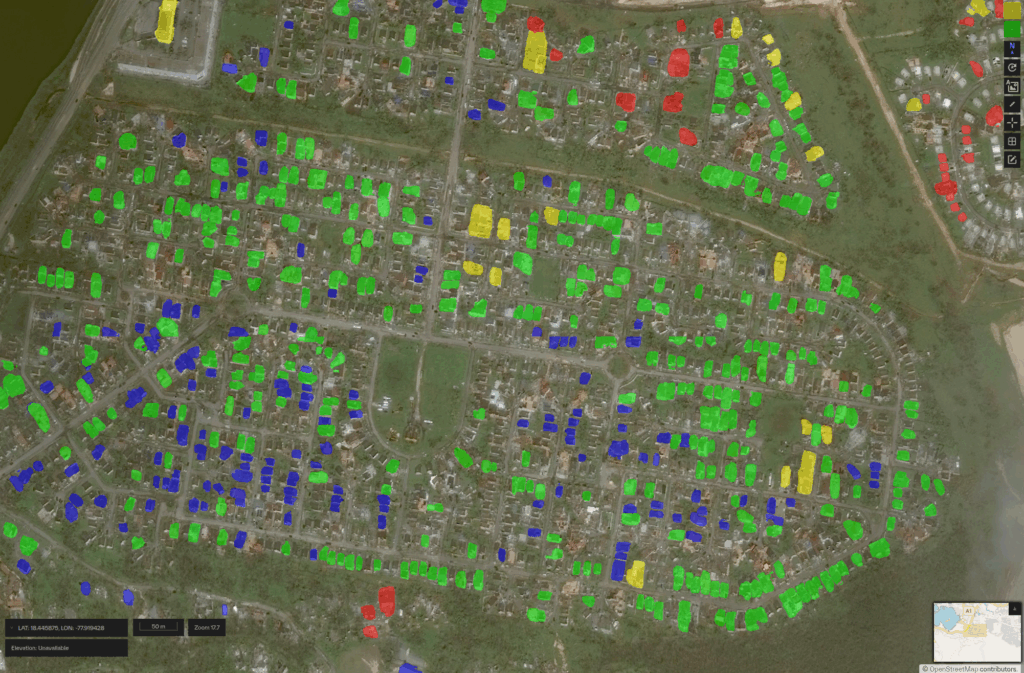
To demonstrate the potential of our technology, we analyzed satellite imagery of Hurricane Melissa’s impact on a subsection of Montego Bay and found that over 61% of the buildings were damaged.
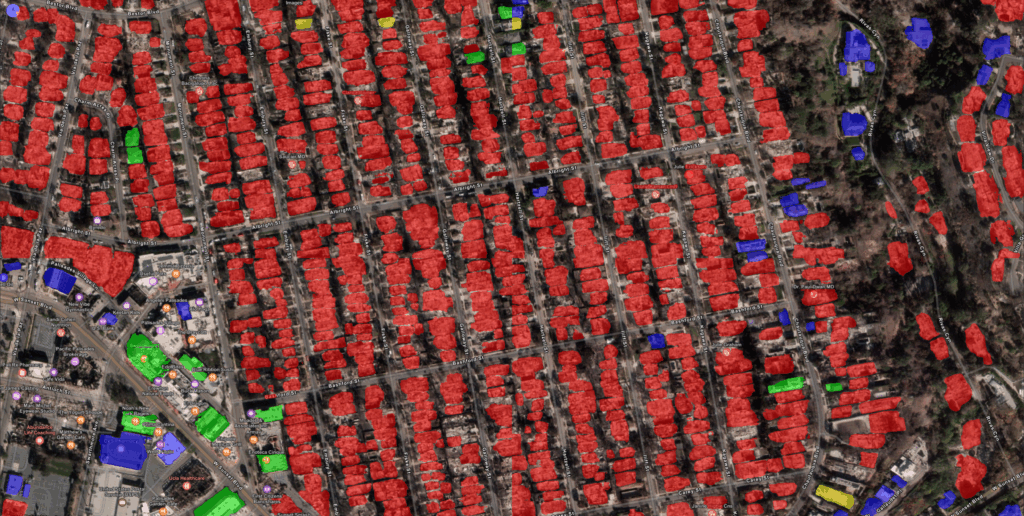
Similarly, we applied our models to satellite imagery from recent Los Angeles wildfires, where our AI showed that 92% of the buildings were reduced to rubble.
Extending real-time processing with Latent AI optimization
The benefits of the AI algorithm also extend to aerial platforms that can autonomously survey the area. Optimized edge AI models with on-board processing on drones and satellites can deliver fast, accurate damage assessments in disaster zones. Latent AI’s optimization process reduces memory usage, accelerates data transfers, and boosts calculation speed, often achieving a 2–4x performance improvement. Our optimizations can reduce GPU requirements by over tenfold compared to unoptimized models, enabling scalable, efficient solutions. This efficiency allows drones to process imagery in seconds, empowering responders with real-time damage assessments to navigate evolving disaster conditions.
Developing more innovative solutions for a resilient future
While edge AI can’t stop natural disasters, it’s a game-changer for disaster response teams. Our lightweight models run on affordable hardware, making them scalable for agencies worldwide.
The devastation from Hurricane Melissa in Jamaica underscores the urgent need for faster, more effective disaster response. Latent AI is working to enhance first responders’ capabilities with optimized edge AI, delivering real-time, precise damage assessments directly from drones and mobile units, even in disconnected environments. By processing imagery in seconds, adapting to evolving conditions, and running efficiently on lightweight hardware, these developing solutions aim to empower responders to prioritize rescues, allocate resources, and rebuild communities more effectively. As natural disasters become more frequent, Latent AI’s efforts to advance edge AI optimization will equip first responders with the tools to act decisively, paving the way for stronger, more resilient communities. Learn more about this technology at latentai.com.
Recent Blogs