





Inside the Defense Autonomy Stack: Autonomy Is Won in the System Behind the System
INTRODUCTION
Autonomy applications are exploding.
The recent wars in Ukraine and the Middle East have settled a debate: autonomous capabilities in uncrewed systems are no longer emerging. They are operational, proliferating, and evolving in contact.
A new model of warfare is creating a more lethal and survivable force for America and allied forces. The Department of War’s AI strategy is explicit on this point: Programs that don’t meaningfully incorporate AI and autonomous capabilities now risk being flagged for budget cuts.
The urgency to field defense autonomy, which is both real and justified, is translating into major industry investment. Application vendors are proliferating, and the market is building momentum around attritable, unmanned systems. To put the growth into perspective, Fortune Business Insights projects the market for autonomous defense platforms will be valued at $198 billion by 2034 (from $59 billion in 2025).
But in the rush to deploy, we risk prioritizing autonomy over structural stability. If the underlying command and control system can’t handle dynamic, high-stakes environments, the system will fail at scale.
That command and control system decides things like: Whose system degrades more gracefully under contested conditions? Recovers more quickly? Adapts more effectively to different mission environments? Maintains lock when a target evades, when GPS drops, or when the link goes down?
As basic autonomy becomes commoditized, the application deployment challenge becomes one of persistence. The real winner is whoever’s software stack holds together on “Day 3”: After the lab and after the demo, when autonomy is in the hands of operators, high-stakes conditions are shifting, and the system has to keep adapting.
In this paper, Latent AI explores what it takes to engineer autonomy for sustained operation in the real world.
- Why the underlying software system is the precondition for Day 3 autonomy
- How to design autonomous systems for persistence and scale
- How we accelerate system-level innovation for autonomy at mission speed
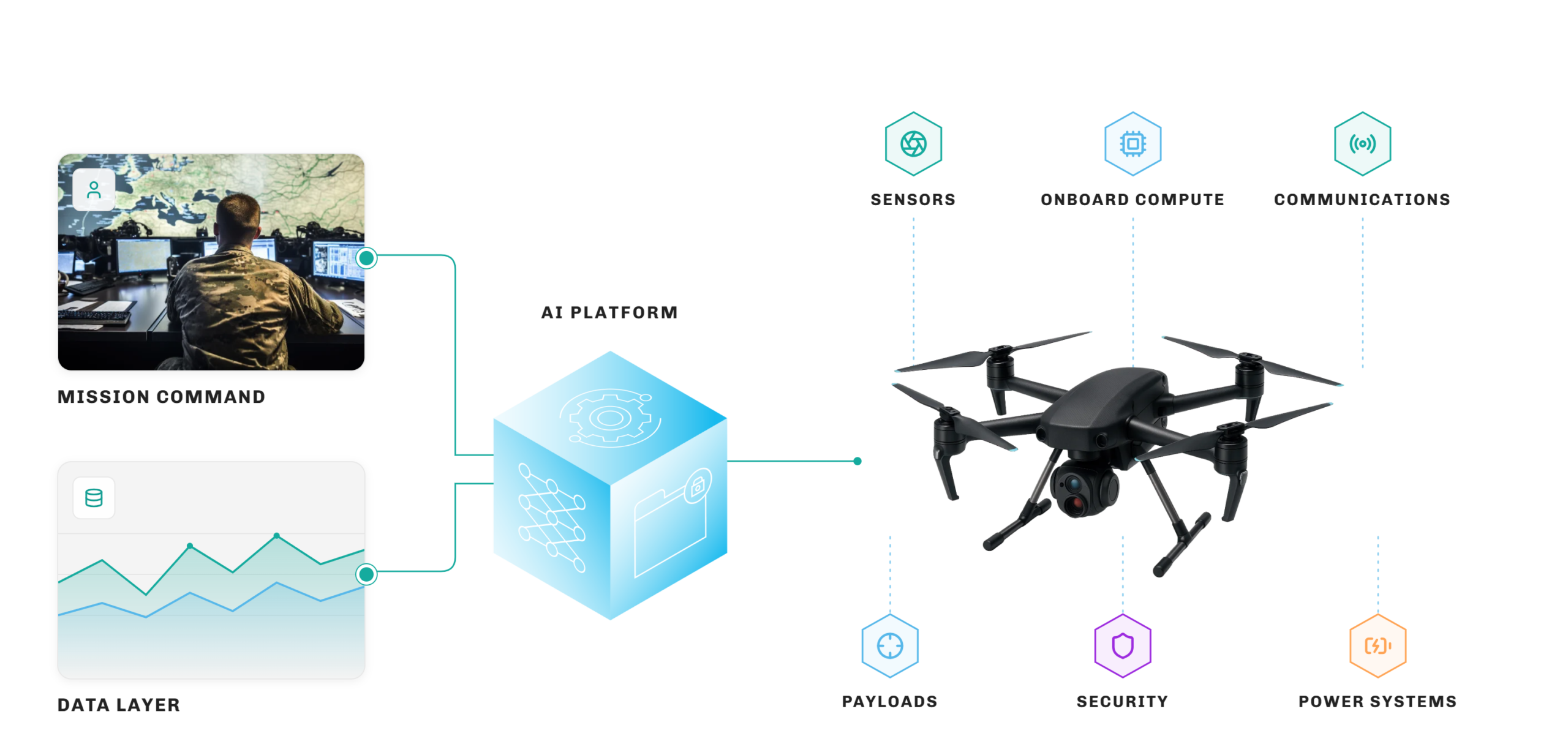
We’ll share a snapshot of our software stack and what needs to work under the hood of mission autonomy at the tactical edge.
PART 1
Operating in wild west conditions
A few short years ago, the idea of self-driving cars traversing through major cities would have sounded wild. Today, riders in places like San Francisco and Phoenix can casually hail a Waymo right from their Uber app.
The auto industry didn’t get to this point by perfecting autonomous vehicles (AVs). The progression from automatic emergency braking to lane assist to adaptive cruise to self-driving was incremental, one bounded task at a time, as engineering capabilities and operator trust developed together. Each step required the software system beneath it to be able to handle the complexities of sensor fusion, real-time inference, and robust tracking.
And still, these cars are anything but perfect. While they increasingly operate on public roads and highways, there are incidents. In early 2026, robotaxis in Wuhan, China stopped running and left passengers stranded in the middle of heavy traffic.
Solving the final hurdles of sensing and unpredictable behavior in autonomous systems requires a shift in focus from the vehicle to the underlying system. Commercial driverless cars are blessed with high-performance hardware and constant network proximity. The real innovation bottleneck? Scaling that intelligence down to harsh, isolated environments that lack the luxury of enterprise connectivity.
What happens to autonomy when the environment isn’t nearly as forgiving?
The engineering hill to climb at the tactical edge
System-level problems always become more acute in denied environments. At the edge, you have smaller devices that need to perform a task, support onboard compute and payload within size, weight, and power (SWaP) constraints, and operate without reliable networking. Engineering involves squeezing a lot into a limited system.
Consider the conditions that autonomy confronts in the mining industry. Unreliable and denied communications. Power and equipment constraints. The inherent risks of operating underground. Compared to driverless cars in major cities, it’s basically the Wild West.
Now, magnify those challenges: Add in lethal adversaries, electronic interference, and shifting mission goals. That’s autonomy on the battlefield. Everything from detection to identification to tracking to decision-making is harder, and the system requirements are seismically more complex.
Here is a simple but stark example of the fundamental differences.
The “standoff distance” is the proximity at which a system can detect, identify, track, and decide. In the commercial world, the standoff distance might be a few hundred feet (e.g., a driverless car must monitor nearby vehicles, pedestrians, and lane boundaries). But in military operations, autonomous drones may need to detect and track targets that are miles away in an environment that is information-poor, degraded, and actively contested. Standoff distance, at the tactical edge, is not just a function of range. It is a function of whether the underlying system is specifically configured for geographically dispersed, dynamic, and unpredictable missions.
Powerful applications will be critical but the systems whose system-level AI is engineered to function in the most demanding and denied edge conditions, will have the advantage.
Are drones able to visually identify targets independently using powerful onboard edge compute? When the signal drops, can the onboard logic maintain its lock and keep functioning without a human-in-the-loop? Can a system fly autonomously while ensuring operations don’t increase the pilot’s cognitive load in the field?
Ultimately, acquiring an autonomous application for the battlefield without asking system-level questions is like buying a self-driving car without asking whether the sensors work in the rain. The capability claim may be real, but trusted field performance is an entirely separate matter.
PART 2
Designing for scale and persistence
The promise of 1-to-many (a single operator in command of uncrewed systems at scale) is too powerful to ignore. It’s also contributing to a lot of hype and glamour surrounding drones and autonomous applications. But despite the hype, most autonomy discussions still focus on whether a system can perform a task under controlled conditions.
Defense systems for detection, tracking, and targeting are easy to demonstrate in testing or in limited or proof-of-concept deployments. If you think about each phase of development as a “day,” here’s the typical sequence:
- Day 0: Data and requirements
- Day 1: Working demo
- Day 2: Small-scale deployment
- Day 3: Sustained operation in the real world
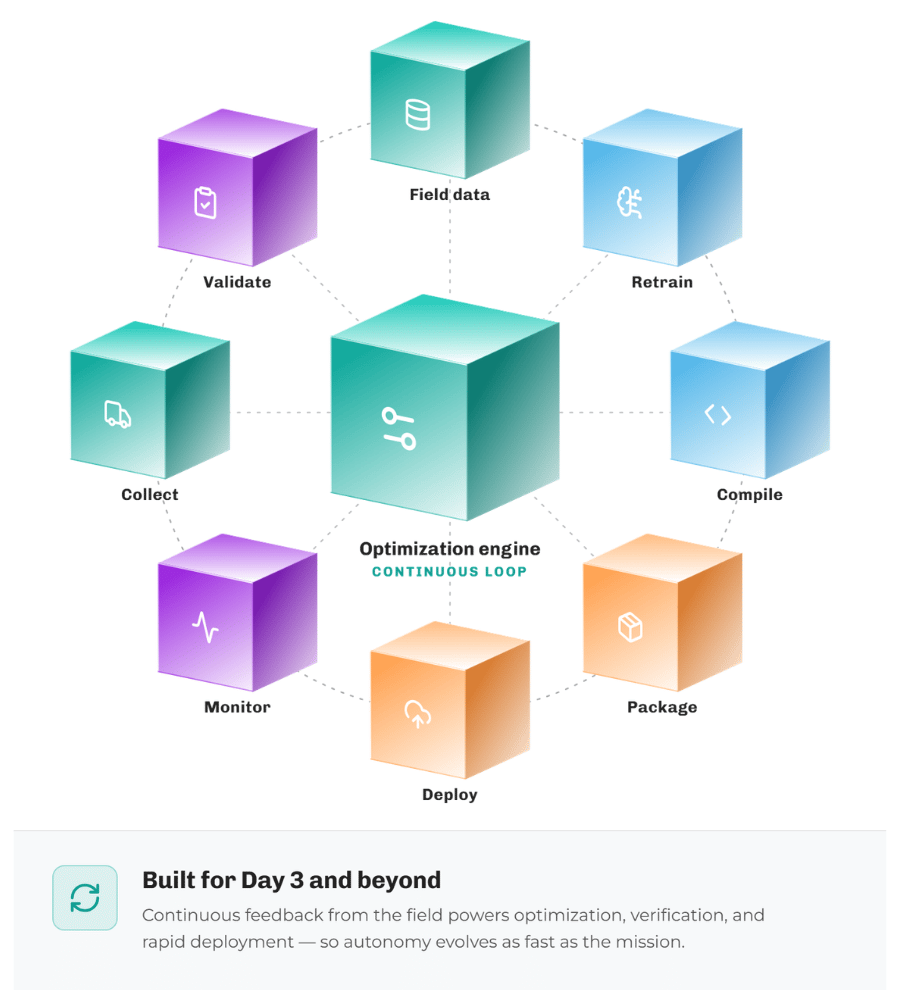
The first few days are mostly solved problems (especially when you don’t start from scratch). The truly hard problem is Day 3: Can the system continue to perform and adapt after rolling out to different missions and hardware platforms at scale, and as the real world gets messy? Solving for Day 3 requires more than better applications and models. It requires system-level orchestration to effectively deploy, track, and manage AI components across not one—but many—variants in the field.
Successful orchestration depends on what’s inside the technology stack. Just as a mission loadout is built for the specific operation, not a generic kit, the technology stack needs the right components and tuned AI for the mission at hand. At Latent AI, here is how we design AI as a piece of the underlying infrastructure for persistence and scale in the real world.
We carve out AI as its own layer.
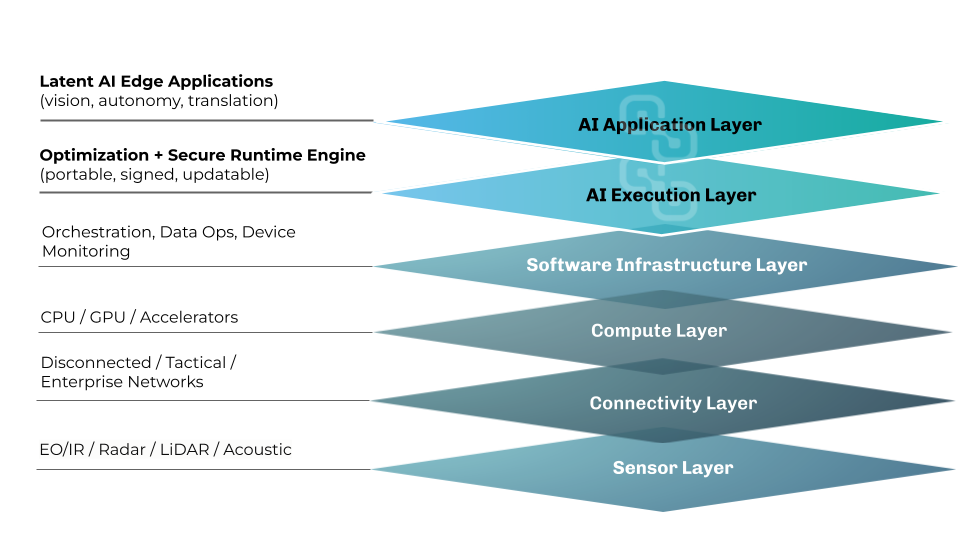
The common technology stack is made up of hardware, the software system (which includes AI), and the application. But for autonomous systems, the component of the stack that matters the most and needs to evolve the fastest is specifically the AI model. Therefore, it’s critical from an engineering standpoint to decouple AI into its own layers, distinct from the infrastructure beneath it (see Figure 1).
Think about the applications that glue everything together for operators to use autonomous systems; they typically don’t change with high frequency. Meanwhile, AI models must be updated on a continuous lifecycle, based on data gathered in the field, unpredictable adversaries, new mission requirements, and real-time dynamics. By separating AI into its own system layers, it becomes much easier to orchestrate machine learning in real time and deploy precise model requirements for specific missions.
We prioritize component interoperability.
By isolating AI as a discrete layer in the technology stack, we significantly increase system flexibility. Our engineers easily swap the AI layer in and out of different system stacks, interconnect it with partner systems, and ensure the AI layer remains portable across a wide range of platforms and system-on-chip hardware—especially with the explosion of autonomy platforms on the market.
In federal acquisition requirements and at field events, customers are mandating interoperability for both mission effectiveness and manufacturability. From the Pentagon’s Drone Dominance Program to the Army’s Operation Jailbreak, the signal is clear: Operators need autonomous systems that can increase survivability and lethality but also interoperate efficiently, without technical friction or unnecessary cost.
We compile once and adapt everywhere.
Orchestrating one model is straightforward, but rolling out AI models at scale across a myriad of systems in different regions around the world is a significant undertaking. How do you make sure the right AI components, tuned to the right contexts, are being rolled out to the right places, and then continuously update with precision?
Our team engineers for individualized but sustainable deployment and maintenance by compiling for runtime at scale. That includes embedding upfront standards like watermarking to encode provenance (variant “X” is for mission “Y”), encryption for safe transit, adversarial input defenses, and algorithmic robustness to ensure models run consistently and at scale in contested environments.
We maximize operations for data collection.
At Latent AI, we believe mission operations should double as data collection opportunities by acting as a “flight recorder.” Therefore, Day 3 is not the finish line but is our opportunity to start an intelligence loop: Flight trials in the field surface new data; the data goes back to the lab; and the AI is then reoptimized and redeployed.
With a pipeline to incorporate this data back from the field, we improve the AI over time, focusing on the model’s life cycle, maintenance, and ongoing improvement rather than just the initial operational deployment. For commanders, this data loop also captures valuable mission insights for post-operation analysis, ensuring reliable operations without external systems.
PART 3
Accelerating system-level innovation
Even if the system behind an autonomous capability is built to work persistently, at scale, and at the tactical edge, that’s not enough for mission advantage. The next issue: Can the system deploy fast enough to meet warfighter needs?
“In the twentieth century, the country that built the first nuclear weapon held the strategic advantage for a generation,” write Kateryna Bondar and Matt Mande in CSIS. “In the twenty-first, the country that builds the orchestration layer for autonomous warfare first will hold a comparable kind of advantage, one defined not by yield but by the speed, scale, and tempo with which it can act.”
Adversaries are rapidly improving low-cost autonomy, and it’s no longer practical or safe for the U.S. to spend months developing and testing software for the battlespace. In today’s fight, “speed wins.”
We see the pace of innovation playing out in Ukraine. Russia’s early Shahed variants were vulnerable to GPS jamming, a weakness Ukrainian forces exploited through extensive electronic warfare. Subsequent iterations have adapted: newer variants incorporate anti-jamming antennas and improved navigation systems that increase resilience to electronic warfare.
This is a pattern we will continue to see across conflicts. The adversary iterates a system. The guidance gets harder to defeat. The cycle of head-to-head innovation accelerates.
As the U.S. military moves fast to buy drones and autonomous applications, new platforms will only matter if the industry can fast-track underlying software innovation and orchestration.
Getting to Day 3 faster
At Latent AI, speed and efficiency are engineering pillars. Our customers don’t just need high-performance models for autonomy; they need cost-effective systems that are quick to manufacture and deploy on their existing hardware.
We believe that system-level updates should never be a reinvention but rather a configuration, whether you’re scaling from 10 devices to 10,000, or you’re updating edge AI models that are actively operating in the field.
Here is how we accelerate system-level innovation for Day 3 autonomy:
Foundation models trained on 2TB of data
Every tradeoff in the system architecture, big or small, fundamentally changes autonomy performance and outcomes. But we can’t waste customer time building components that have already been built or solving old problems. With a library of over 1,000 pre-tested model-hardware combinations, Latent AI engineers jump to mission customization in a matter of hours (not weeks).
These foundation models make it easy to tackle optimization upstream. Instead of training large models and retrofitting them later to hardware and requirements, we quickly produce and test architectures designed for specific environments from the outset. For example, we may tune more for low SWaP and low latency in Group 1 drones—and then prioritize endurance and model agility for Group 2 drones. With a fast, sustainable pipeline for autonomy innovation, where we simply adjust the dials to optimize for mission requirements, we spend more time focused on the art of the possible.
Joint development of perception and control
In the past, edge AI was all about perception: Perhaps a system had to detect or track an object. With physical autonomy at the edge, perception is only the first step. A complete solution has to perceive, decide, and act—and all three have to work together, fast, before the moment passes. For example, if an operator needs to track a fast-moving object, they need the steering of the camera to fixate on the target and the perception models to kick in. These two elements need to work together seamlessly before the object disappears.
At Latent AI, we jointly develop and tune perception and autonomous behavior, rather than treating them as separate systems. By optimizing for all at the same time, we make improvements to the whole system. That way, each is built to compensate for one another in the field. Say the detection is uncertain; the steering then zooms in on the target. The result of joint development is not just more accurate perception and control, but a faster pipeline to reliable autonomy.
Simulation to quickly test scenarios and tradeoffs
For drone autonomy systems, we use digital twin simulations to stress-test tactics, techniques, and procedures (TTPs) against adversaries, optimize mission scenarios in the actual operating environment, and find corner cases that aren’t readily available in captured data. In simulated environments, our engineers rapidly characterize outputs and flight dynamics against different environmental conditions (e.g., rain vs. fog vs. sunlight) and iteratively tune flight control and detection algorithms for mission readiness.
Beyond speeding up system development, simulation also lets us push the envelope on autonomy and test more complex conditions. For example, what happens when a target moves behind terrain or buildings, or when two similar drones cross paths and then one breaks off? The simulator tests system performance when there’s partial or full occlusion, and whether the algorithm can persist in dynamic operations that demand higher accuracy.
For operators, simulation allows them to feel the physical effects and momentum of a system, review simulated intelligence, practice selecting targets, and understand the expectations and outcomes before deployment.
Conclusion
Autonomy that holds up on Day 3
Recently, reports from Ukraine indicated that drones carried out more than 22,000 missions in three months. This heavy focus on unmanned systems has put robots in the line of fire, instead of human operators.
Defense autonomy is urgent. But as U.S. and other state actors converge on similar capabilities, we believe the market is over-indexed on terminal guidance (application-layer innovation) and under-indexed on the foundational AI stack and system reliability at the edge.
That’s where autonomy either holds up or it doesn’t.
By focusing on system-level optimization, the art of the possible starts to expand dramatically—precisely because there are so many technical tradeoffs and options behind the scenes. For example, instead of being limited to small, first-person-flown Group 1 drones, it’s possible to pick and choose from a robust, mission-aligned menu of autonomy variables.
Ultimately, it comes down to trust.
When you look past the hype of drones and swarms and terminal homing, there’s the warfighter, the mission, and military doctrine. What matters is how autonomous systems hand off control to human operators for reasoning and critical decision-making.
So, once you get the underlying AI system right, the underlying components need to connect with the human experience: Where is the C2 handoff between AI and human? How far up in the chain does it happen? How is control integrated into the ATAK ecosystem? What’s given to operators to make final command decisions? And how do they respond and interact with the system?
These are some of the questions Latent AI is helping the Army work through in their first-ever AI program of record, Project Linchpin. Through test and evaluation (T&E), we are qualifying that AI is ready to deploy and will adapt in the field; the interface mechanism is ready for operators to engage with it; and the models meet confidence levels for soldiers to make rapid decisions and execute courses of action.
Maintaining a lead in the race for autonomy.
While autonomous applications are essential to missions today, the true differentiating factor for the U.S. on tomorrow’s battlefield is the software and orchestration system under the hood. That will be America’s competitive advantage in the race for defense autonomy.
Platforms can get a system into operation. Whether it holds up—on Day 3, and beyond—comes down to the AI stack underneath.
Recent White Papers